16/01/2026
LiCORNE attends the 4th edition of the Cluster Hub’s annual workshop
Production of raw materials for batteries from European resources
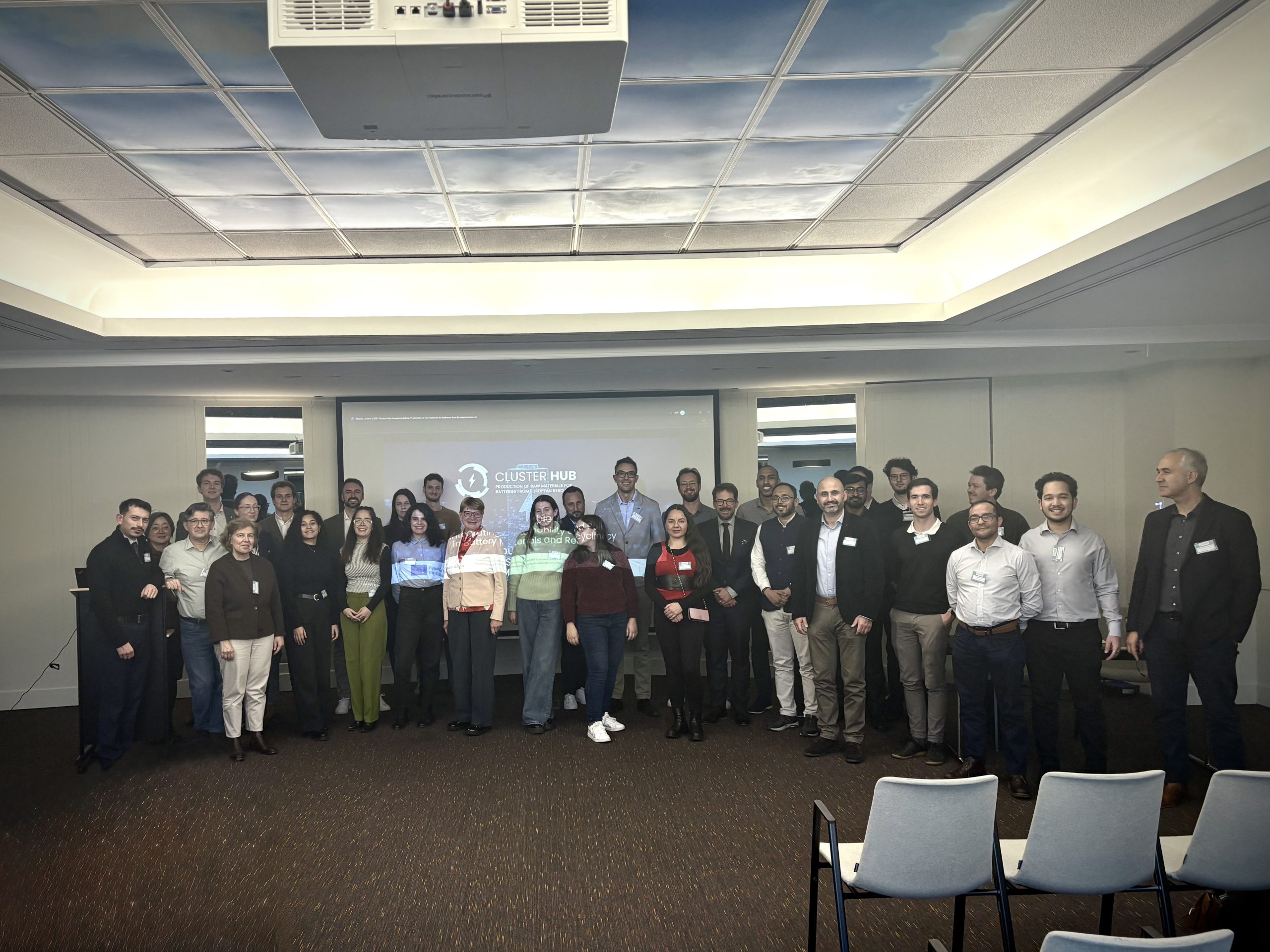
After Wednesday’s sessions on the EU political agenda, which outlined strategic measures to meet industry needs, attention shifted to the annual workshop of the Materials for batteries hub. Now in its 4th edition, the event was co-organised by Horizon Europe projects RELiEF, FREE4LIB, RESPECT and LITHOS. The focus of the workshop, true to its eponymous theme, was tackling one of Europe’s most urgent challenges: securing sustainable raw materials for batteries.
Under the inauguration of Oliver Schenk, Member of the European Parliament, this edition unfolded under the auspices of urgency, regulatory clarity and cross-border collaboration. The MEP called for swift implementation of the Critical Raw Materials Act and the Net Zero Industry Act, stressing the need for rapid permitting and the mobilisation of both public and private investment. “We cannot afford delays,” he warned. “This is about sovereignty.” His remarks were followed by strong appeals for cooperation among mining regions, manufacturing clusters, research centres and recycling hubs to build a resilient European value chain. He urged participants to contribute to upcoming legislative files, including the European Chips Act 2, the Circular Economy Act and the new EU budget, ensuring that the priorities of the battery materials community are embedded in future policies.
Nader Akil, founder of the Cluster Hub and moderator of the first technical session, emphasised on enhancing the dialogue between academia, industry and policy makers in order to ensure that these goals would be reached.
Following up with a presentation of his most recent scientific publication – “Lindy Effect in Hydrometallurgy” [co-authored with Dr. Ir. Peter Tom Jones] – Professor Koen Binnemans provided a frank look at the shortcomings in industrialising battery material innovations. Transferring hydrometallurgical advancements from lab to plant is slow, constrained by economics, regulation and what the authors call “the Lindy effect” – the tendency for established technologies to stand the test of time. Industry tends to favour incremental improvements to existing processes, such as reducing reagent consumption or increasing automation, rather than adopting entirely new chemistries, due to the high risks and costs associated with large-scale change. Launching a debating topic, audience questions shifted to technical and permitting challenges, concluding with the need for incremental innovation and pragmatic timelines.
Download the presentation
Various EU-funded R&I initiatives, members of the Cluster Hub, presented results and findings with the promise to reduce dependency on imports. LiCORNE project presented its intermediary results within the technical session “Mining and recovery”, alongside sister projects XRACT, CRM-Geothermal, METALLICO, ENICON LITHOS and RAWMINA.
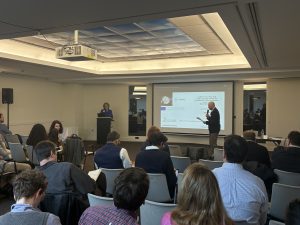
- LiCORNE, represented by Dr. Lourdes Yurramendi (TECNALIA), and focusing on lithium recovery and battery-grade material production from European resources, presented the outcomes of its intensive techno-economic assessments and the selected flowsheets for lithium extraction and processing technologies for diverse streams, such as ores, brines and off-specification cathode material.
Download LiCORNE presentation - Sabrina Hedrich from TU Bergakademie Freiberg detailed the XRACT project’s pilot sites and the integration of digital tools, remote sensing, and bioleaching for selective recovery of metals, with follow-up technical discussion on downstream processing and environmental permitting.
Download XTRACT presentation - CRM-Geothermal, presented by Konstantinos Loupos (INLECOM), has developed an AI-based tool for lithium estimation in geothermal fluids, with features and validation at a UK demonstration site.
Download CRM-geothermal presentation - METALLICO and ENICON, represented by Sonia Matencio (CETAQUA) and Brecht Dewulf (KU Leuven), aim to demonstrate sustainable recovery of battery metals from primary and secondary sources, focusing on process integration, digital tools and circular hydrometallurgy. METALLICO demonstrates five processes for recovering metals such as lithium, copper, cobalt, and manganese from various sources, with a digital tool for simulating process outcomes and pilot-scale validation of key steps like sulphide precipitation, ion exchange, and diffusion dialysis.
Download METALLICO presentation
ENICON targets responsible mining and refining of cobalt and nickel in Europe, developing improved flow sheets for laterites, sulfides, and intermediates, and validating circular hydrometallurgy concepts with high recovery rates and valorisation of mineral residues.
Download ENICON presentation - Thomas Abo Atia (KU Leuven) introduced the LITHOS project which focuses on domestic processing and refining of lithium from European hard rock deposits, integrating advanced mineral processing, digital twins and LCA to reduce environmental impact and support EU supply chain targets. Like many EU-funded initiatives at KU Leuven exploring primary resources, LITHOS introduced the “Lithium paradox” – the latest episode of the documentary co-produced by SIM² KU Leuven (Institute for Sustainable Metals and Minerals) and the Belgian film-maker company Storyrunner.
Download LITHOS presentation - Diego Morillo Martín (LEITAT) presented one of the most mature projects of the hub – RAWMINA, an EU-funded initiative aiming to transform mine waste into resources through scalable bioleaching, alkaline leaching and selective recovery of critical and valuable metals, with pilot-scale demonstrations developed at Cobre las Cruces. The project reported achieving high recovery rates for cobalt, antimony, germanium, tungsten, iron, gold and silver, and validating nanomaterial-based selective recovery and water reuse.
Download RAWMINA presentation
Debating industrial integration, collaboration and European competitiveness
Two panels framed the bigger picture. The first one, chaired by Nader Akil (PNO Innovation Belgium), addressed scaling up technologies and reducing mining’s environmental footprint, with strong emphasis on AI and data-driven processes.
- Panellists -Sabrina Hedrich, Kostas Loupos and Diego Morillo Martin – listed the integration of digital tools, remote sensing and bioleaching as core to reducing mining’s environmental footprint, with validation across multiple pilot sites.
- The value of AI in resource estimation depends on the availability and integration of diverse data sources, with more data enabling better predictions and process optimisation.
- Scalability was discussed in terms of achieving higher TRL levels, with bioleaching and selective recovery identified as critical steps, and the need for further work on final product purity and process integration for marketable outputs.
- Audience questions addressed the impact of strict regulations on competitiveness, the need for closer industry-research collaboration, and the lack of dedicated funding mechanisms for critical raw material projects, with suggestions for policy recommendations and strategic investment.