16/01/2026
LiCORNE selects three lithium recovery flowsheets for upscaling
The Horizon Europe project LiCORNE has completed an important milestone in its journey to establish a sustainable lithium supply chain in Europe. At the end of 30 months of research and technical development, the project consortium has selected three process flowsheets for upscaling. These routes represent the most promising routes for lithium recovery from European resources: ores, brines and off-specification battery cathode materials (waste).
Why this matters? Europe, from its position as an ambassador of the green transition, is expected to see a major increase in demand for lithium. Yet, its contribution to the lithium supply chain remains modest, despite holding an estimated 5 % of the global reserves. Most of this lithium is locked in hard-rock deposits, which are generally costly and environmentally challenging to extract. Domestic mining projects often face public resistance, while refining capacity remains limited.
Moreover, JRC’s studies indicate that despite a projected increase in EU’s battery cell production, the bloc remains import-reliant for battery-grade materials. Refined lithium inputs are expected to come increasingly from new EU mines, provided critical bottlenecks, such as domestic conversion and refining are removed. The Commission’s JRC additionally estimated that by 2040 recycled cobalt and nickel could meet up to 51 % and 42 % of EU demand, respectively.
LiCORNE, short for Lithium recovery and battery-grade materials production from European resources, is one of the numerous R&I initiatives launched to address this strategic vulnerability. The project aims to build Europe’s first integrated lithium supply chain. Its mission spans beyond simply optimising technological processes to recover lithium and battery-grade materials, aiming to provide solutions that are both efficient, scalable and sustainable.
Assessments and selection of flowsheets
After three years of research and technology optimisation, the LiCORNE consortium has selected the flowsheets that will be further upscaled during the project’s last 12 months. This selection followed a two-step assessment:
- Individual technology evaluation: 14 technologies developed and optimised within the technical work packages were assessed for environmental impact (via Life Cycle Assessment – LCA), economic performance (via Life Cycle Costing – LCC) This comprehensive assessment revealed additional insights that served as guiding lines in further optimisation at lab scale.
- Flowsheet integration and ranking: the most promising technologies evaluated in the first assessment were combined. Each flowsheet was later evaluated using a ranking value that integrated LCA, LCC and product quality metrics. The functional unit applied to all process routes referred to 1 kg of lithium recovered in the final product, thus ensuring consistency and fair evaluation across different lithium compounds.
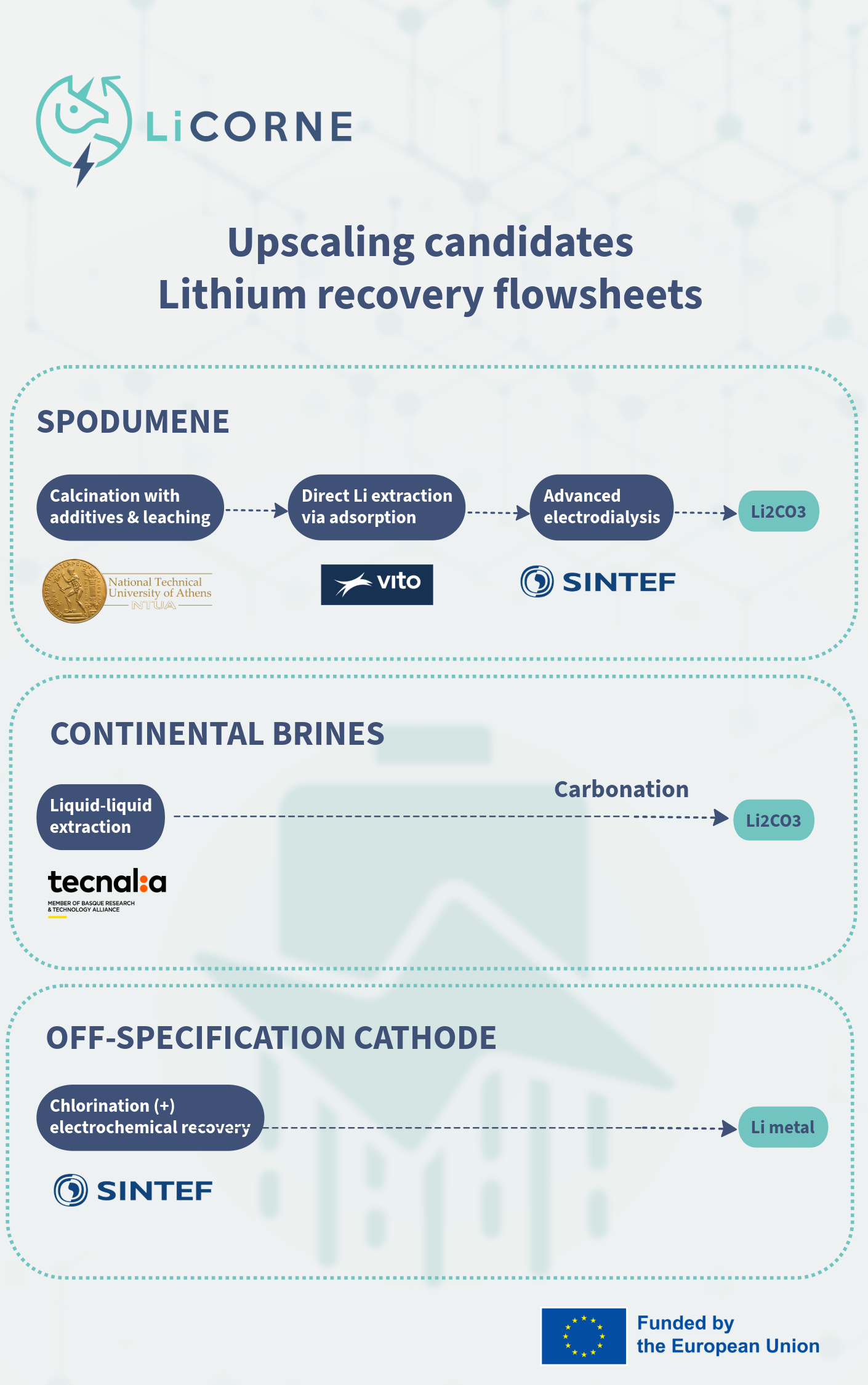
The final ranking identified the following three flowsheets as candidates for upscaling:
1. Spodumene route:
- Partners: NTUA, VITO, SINTEF
- Technologies: Calcination with additives and leaching, direct lithium extraction via adsorption, advanced electrodialysis
- Final product: Lithium carbonate
- Highlights: Balanced environmental footprint and cost; 84% final yield
2. Continental brine route:
- Partner: TECNALIA
- Technology: Liquid-liquid extraction, followed by carbonation
- Final product: Lithium carbonate
- Highlights: High product purity; low LCA score; lowest LCC among brine routes
3. Off-specification cathode:
- Partner: SINTEF
- Technologies: chlorination and electrochemical recovery
- Final product: Lithium metal, cobalt and nickel
- Highlights: Efficient recovery of multiple critical metals; low environmental impact
A feasibility study was performed for the three candidate flowsheets before moving into scale-up phase. The study confirmed their readiness for implementation in line with equipment requirements, scalability and the project’s remaining budget envelope.