08/06/2026
LiCORNE pilot units progressing towards TRL5
At the end of 30 months of research and technical development, the project consortium has selected three process flowsheets for lithium recovery treating three types of sources: ores, brines and off-specification battery cathode materials (waste). Upscaling operations are now underway across all three processing routes. NTUA, VITO, SINTEF and TECNALIA have already started first experiments at TRL5, using the equipment and operating conditions scaled up from earlier laboratory development stage.
During the latest consortium meeting, hosted by SINTEF in Trondheim, partners presented the current status of each technology with the first batch of results, which will be guiding the next technical steps.
Spodumene route
The spodumene route proposes a combination of complementary technologies: NTUA’s calcination with additives and leaching, VITO’s direct lithium extraction via adsorption, followed by SINTEF’s advanced electrodialysis. The final product expected is lithium carbonate.
NTUA has already completed a first pilot-scale run of the spodumene route and shipped the resulting sample to VITO for downstream processing. Although in this initial run, lithium recovery did not reach the laboratory values (83.7% final yield), sufficient solution was obtained to feed the pilot sequence. Similar to the laboratory results, impurities level remains relatively low. During the upcoming months, NTUA will continue adjusting process conditions to improve the recovery yield.
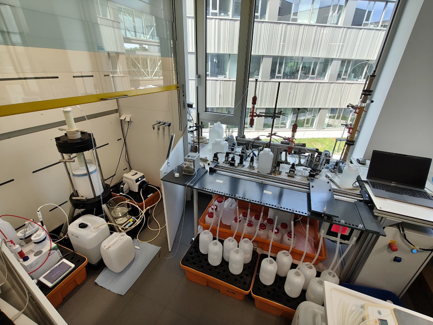
The samples have now reached VITO’s laboratories for the second processing step of this route. After finalising two adsorption/desorption cycles, VITO researchers have already established the base operation parameters to purify the spodumene leachates, reporting 70% yield. With a large processing capacity (treating 20L/day), the research team at VITO is planning to ship the samples towards SINTEF in June, for the final lithium hydroxide production step.
©VITO ion-exchange purification setup based on H2TiO3 beads, featuring automated adsorption and pH-controlled regeneration
Brine route
Although still pending some equipment parts, TEC continues operating the brine route using liquid–liquid extraction from continental brines, followed by carbonation to lithium carbonate. Pilot operation is focused on recovery efficiency, stability, and energy use at scale. The material produced feeds directly into validation and sustainability assessments. The research team at TECNALIA already achieved 79% yield (higher than lab results reaching 68%), but improvement operations are ongoing, aiming 91% overall extraction efficiency assumed from the McCabe-Thiele analysis from lab results.
Off-specification cathode material
SINTEF is advancing the upscaled treatment of off-spec cathode material using their chlorination process, followed by electrochemical metal recovery. Pilot operation is aiming particularly at recovery efficiency lithium, low environmental impact and process scalability.
Given that the recovered product from this material is not lithium carbonate but lithium metal, SINTEF will review existing industrial practices for this pathway to define an appropriate benchmark.
The selected flowsheets will further undergo experimental tests towards obtaining high purity products. Once implemented, the consortium will reevaluate the environmental and economic performance of these flowsheets to identify opportunities for further optimisation.
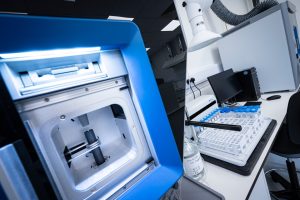
ICP-OES analytic system at the LevertonHELM testing facility in Basingstoke, ©LevertonHELM
All materials produced by the three routes will be characterised using a single analytical framework. The team at LEVERTON, helped by SQM, will validate Li material, while UMICORE will mainly provide their industrial assessment of Co and Ni. Using one laboratory and procedure reduces variability and allows direct comparison between the three routes. This aspect becomes increasingly important when generated data will feed technical validation and downstream assessment activities.